Wizard Condenser Fan Control System |
|
||
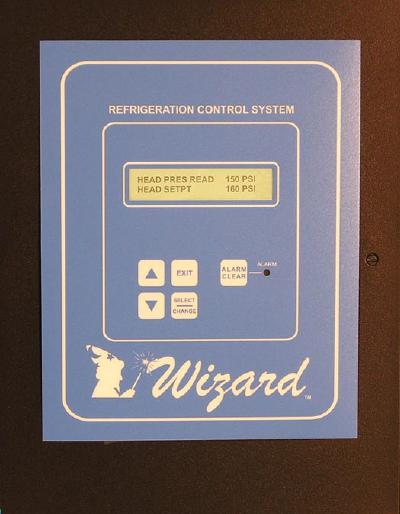
Features The WCFC is the most advanced condenser system controller in the industry today. The control will efficiently cycle up to seven fan banks or six fan banks with split condenser, controlling the discharge pressure effectively. The WCFC was engineered to meet the two main variations in systems today; fixed head and floating head. The Fixed head control will sequence fans based on discharge pressure, while floating head control will sequence fans based on discharge pressure and liquid temperature. The control has a 10 character alphanumeric vacuum fluorescent display, four input keys, integrated input terminals and output relays on a single P.C. Board. The compact design makes this Control very reliable. It is designed to operate from -30°F to 150°F ambient temperature. Menu driven software eases operating parameter changes and setting adjustments. The WCFC was engineered to meet the two main variations in systems today; fixed head & floating head. The fixed head control will sequence fans based solely on discharge pressure with optional ambient temperature sensors to optimize the fan cycling speed. Floating head control will sequence fans based on discharge pressure and liquid temperature. Sequential Staging -- The WCFC will sequentially stage the fan banks in the FILO format (first on last off). The fan bank closest to the condenser input manifold should always be assigned as the first, or primary, fan bank. The WCFC will keep the first fan bank running nearly constantly to prevent expansion and contraction at the pipe and tube sheet joints. Parallel Fan Bank Control -- If the condenser has a primary side and a secondary, or split, side with fans on each side, both sets of fans should be controlled by the same condenser relay. The contactor power for the split fans should also be controlled by the Split Condenser Relay on the WCFC Condenser Board. Fixed Head Pressure Control -- The WCFC can stage the condenser fan banks based upon a fixed head pressure setpoint. For fixed head operation, the controlling parameter is discharge pressure with an ambient temperature sensor to optimize the fan cycling speed. The set point for discharge pressure is user definable in the system menu and is modified when defrost or heat reclaim is turned on. The condenser fan control will cycle fans on at a point 5% above this set point, and cycle fans off 2.5% below this set point. This will maintain the average discharge pressure at the set point pressure.
Floating Head Pressure Control -- The WCFC can stage the condenser fan banks based upon the temperature of the liquid drop leg temperature and ambient temperature. The WCFC will maintain the liquid at the Ambient Sub Cooled Refrigerant Setpoint. For floating head control, all setpoints are internally calculated based on the setting. It is labeled T OFFSET (Condenser Temperature Offset) and is located in the SYSTEM menu. The liquid line temperature setpoint is equal to ambient temperature plus the condenser offset temperature. The condenser offset temperature is adjustable from 6 - 25 deg F. The effect of this setting is the amount of subcooling the Condenser control will maintain. A lower offset value will tend to increase the amount of subcooling.
The range of the liquid temperature set point is 40 - 100 deg F. If the calculation method had a liquid temperature set point below 40 deg F, the control will default to 40 deg F, and if the calculation exceeds 100 deg F, the control will default to 100 deg F. The discharge pressure setpoint is determined from a saturation curve. Different refrigerants have different saturation curves. The range of the discharge pressure setpoint is 148 psig - 250 psig for R-502 for example. The fans are cycled first according to the head pressure. Once the head pressure is satisfied, the fans are cycled by the liquid line temperature. In order to obtain optimal sub-cooling to the liquid refrigerant, the flooding valve in the rack should be set 5 lbs below the minimum (flooding) head pressure setpoint. The defrost status adjusts the discharge pressure setpoint according to the minimum defrost head pressure setpoint that can be adjusted in the System menu. Set the minimum defrost head pressure setpoint lower than standard setpoint, or zero if boosting pressing is not needed. The heat reclaim status adjusts the discharge pressure setpoint according to the minimum heat reclaim head pressure setpoint that can be adjusted in the System menu. Set the minimum heat reclaim pressure setpoint lower than standard setpoint, or zero if boosting pressing is not needed. Split Condenser -- The WCFC will attempt to maintain the condenser in its smallest configuration. If the WCFC can maintain the head pressure while in the "split condenser" mode even though the ambient temperature is above 70 °F, the WCFC will do so. The WCFC will lock into the Split mode when the ambient temperature is below a setable ambient temperature Setpoint. The WCFC will only come out of split condenser when the following occurs:
When the WCFC goes into Split Condenser, the WCFC closes the Split Condenser Relay, closing the split valve and shutting power off to the split side fans, and will automatically double the number of fan banks previously being run. When the WCFC comes out of Split, the Split relay will open, and the number of fan banks being run will be halved. Ambient Temperature Compensation of the Fan Start/Stop Timing -- The WCFC will adjust the start and stop timing of the condenser fans based upon the ambient temperature. The WCFC will more than likely start fans faster when the ambient temperature is warmer and will stop fans faster when the ambient temperature is cooler. Minimum Head Pressure During Heat Reclaim -- When the WCFC detects the Heat Reclaim relay is energized, the WCFC will maintain a minimum head pressure by reducing the number of fan banks active and adjusting the compressor staging. Minimum Head Pressure During Gas Defrost -- The WCFC will maintain a minimum head pressure by reducing the number of fan banks active and slowing the compressor staging. Fan Staging After Gas Defrost --The WCFC will adjust the fan control algorithm immediately following the end of a gas defrost. The WCFC will anticipate the increase of load due to the recovery time of the defrost circuit.
|
|||